Lecture 1: Introduction to Accounting
1. Welcome & Lecture Overview
Welcome to Financial Accounting I. This is your first lecture, titled “Introduction to Accounting.”
Accounting is often called the “language of business.” Just as you need to understand a language to read a story, you need to understand accounting to read the “story” of a business—how it performs, what it owns, what it owes, and how it creates value.
In this lecture, we will build the foundation for everything that follows in this course: the accounting cycle, journals, ledgers, trial balance, and financial statements.
2. Learning Objectives
By the end of this lecture, you should be able to:
- Define accounting and financial accounting.
- Explain the purpose of accounting and why it matters.
- Identify the main users of accounting information (internal vs external).
- Describe the basic forms of business organization and their implications for accounting.
- State and apply the accounting equation:
Assets = Liabilities + Owner’s Equity
- Understand how business transactions affect the accounting equation.
- Appreciate the role of accounting in decision-making and in the broader economy.
3. What Is Accounting?
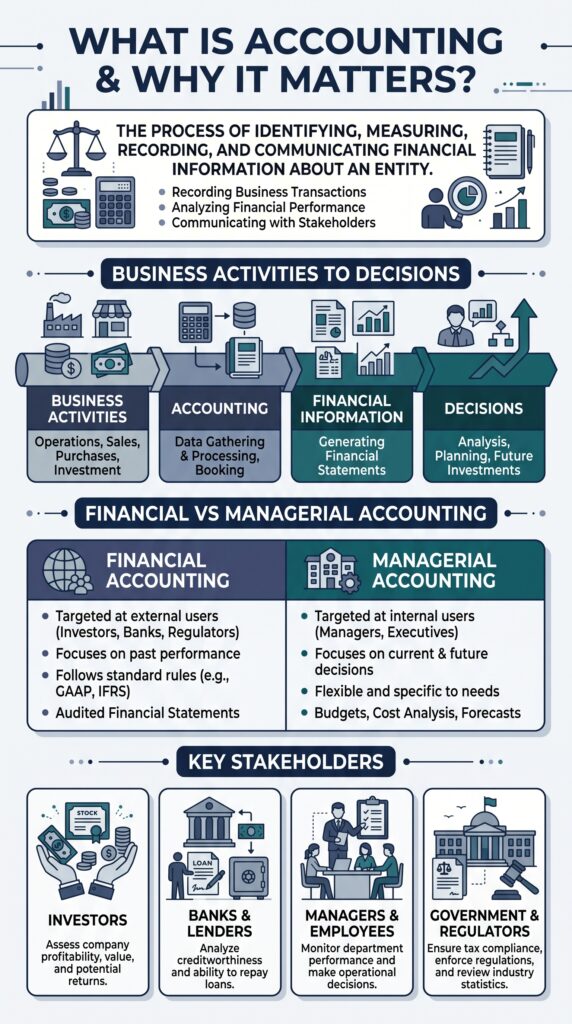
Accounting is the process of:
- Identifying economic events (transactions)
- Recording them in a systematic way
- Measuring them in monetary terms
- Classifying and summarizing the data
- Communicating financial information to users
In simple words: accounting turns business activities into numbers and reports that people can use to make decisions.
3.1 Financial Accounting vs Managerial Accounting
- Financial Accounting:
- Focus: External users (investors, creditors, regulators, public).
- Output: Financial statements (income statement, balance sheet, cash flow statement, statement of changes in equity).
- Governed by standards such as IFRS or US GAAP.
- Managerial (Management) Accounting:
- Focus: Internal users (managers, executives, employees).
- Output: Budgets, cost reports, performance reports, forecasts.
- Used for planning, control, and internal decision-making.
In this course, we focus on financial accounting.
Real-world example:
- A small shop owner records daily sales and purchases to know if the business is profitable.
- An investor reads a company’s financial statements to decide whether to buy its shares.
4. Purpose and Importance of Accounting
4.1 Main Purposes of Accounting
Accounting exists to:
- Provide reliable financial information to stakeholders.
- Measure performance (profit or loss) over a period.
- Show financial position (what the business owns and owes) at a specific date.
- Support decision-making by investors, creditors, managers, and regulators.
- Ensure accountability and transparency in the use of resources.
4.2 Why Accounting Matters in the Economy
- Enables capital markets to function: investors need trustworthy information to allocate capital.
- Helps banks and lenders assess credit risk before giving loans.
- Supports taxation and regulatory compliance.
- Assists managers in planning and controlling operations (pricing, cost control, expansion).
Examples:
- A bank reviews a company’s financial statements before approving a business loan.
- An investor compares two companies’ profitability and risk before investing.
- A tax authority uses accounting records to verify taxable income.
5. Users of Accounting Information
Accounting information is used by many different groups. We classify them as internal and external users.
| User Group | Examples | What They Want to Know |
|---|---|---|
| Internal Users | Managers, owners, employees | Profitability, costs, budgets, performance, incentives |
| External – Investors | Shareholders, potential investors | Returns, growth, risk, dividends, future prospects |
| External – Creditors | Banks, suppliers, bondholders | Ability to repay loans, creditworthiness, liquidity |
| External – Regulators | Tax authorities, securities commissions | Compliance, correct tax calculation, transparency |
| Other External Users | Customers, analysts, public | Stability of the business, ethical practices, social impact |
Key point:
- Financial accounting primarily serves external users.
- Managerial accounting primarily serves internal users.
6. Forms of Business Organization
The way a business is organized affects its accounting. The three main forms are:
6.1 Sole Proprietorship
- Owned by one person.
- Simple to set up; common for small shops, freelancers, consultants.
- Owner has unlimited liability (personal assets can be used to pay business debts).
- Accounting focuses on:
- Owner’s capital (investment + profits)
- Drawings (withdrawals by the owner)
6.2 Partnership
- Owned by two or more persons (partners).
- Governed by a partnership agreement.
- Each partner has a capital account; profits are shared as per agreement.
- Partners usually have unlimited liability (unless it’s a limited partnership).
6.3 Corporation (Company)
- A separate legal entity from its owners (shareholders).
- Owners have limited liability (they can lose only what they invested).
- More complex accounting:
- Share capital (money raised by issuing shares)
- Retained earnings (accumulated profits not distributed as dividends)
- Dividends (distribution of profits to shareholders)
- More regulatory and reporting requirements (especially for listed companies).
Why this matters: Different forms have different equity structures and reporting needs, but all use the same basic accounting equation.
7. The Accounting Equation – Core Concept
The accounting equation is the foundation of financial accounting:
This equation must always balance.
7.1 Assets
Assets are resources owned or controlled by the business that are expected to provide future economic benefits.
Examples:
- Cash
- Accounts receivable (money owed by customers)
- Inventory (goods held for sale)
- Land, buildings, equipment
- Investments, prepaid expenses
7.2 Liabilities
Liabilities are obligations of the business; amounts owed to outsiders that will require future outflows of resources.
Examples:
- Accounts payable (money owed to suppliers)
- Notes payable, bank loans
- Accrued expenses (e.g., unpaid salaries, utilities)
- Unearned revenue (cash received in advance for services not yet provided)
7.3 Owner’s Equity (Shareholders’ Equity)
Owner’s equity is the residual interest of the owners in the assets after deducting liabilities.
For a sole proprietorship:
Owner’s Equity = Owner’s Capital − Drawings + Profits
For a corporation:
Shareholders’ Equity = Share Capital + Retained Earnings − Dividends
Equity increases with:
- Owner investments
- Profits (revenues − expenses)
Equity decreases with:
- Owner withdrawals (drawings/dividends)
- Losses
7.4 Simple Numerical Example
Scenario 1 – Business starts:
- Owner invests Rs 200,000 cash in the business.
- No liabilities.
Equation:
Scenario 2 – Business borrows from bank:
- Business borrows Rs 100,000 from a bank.
- Cash increases by 100,000.
- Bank loan (liability) increases by 100,000.
New equation:
Both sides = 300,000 → equation is still balanced.
8. How Transactions Affect the Accounting Equation
Every business transaction affects at least two elements of the accounting equation, keeping it in balance. This is the basis of double-entry accounting.
Below are common types of transactions and their effects.
8.1 Example Transactions
- Owner invests cash in the business
- Cash (Asset) ↑
- Owner’s Capital (Equity) ↑
- Purchase of equipment for cash
- Equipment (Asset) ↑
- Cash (Asset) ↓
- Total assets unchanged; liabilities and equity unchanged.
- Purchase of inventory on credit
- Inventory (Asset) ↑
- Accounts Payable (Liability) ↑
- Payment of accounts payable
- Cash (Asset) ↓
- Accounts Payable (Liability) ↓
- Providing services for cash
- Cash (Asset) ↑
- Revenue ↑ → increases Equity (via retained earnings).
- Owner withdraws cash (drawings/dividends)
- Cash (Asset) ↓
- Owner’s Equity ↓ (through drawings or dividends).
8.2 Transaction Effects Table
| Transaction | Assets | Liabilities | Equity |
|---|---|---|---|
| Owner invests cash | ↑ Cash | — | ↑ Capital |
| Buy equipment for cash | ↑ Equipment, ↓ Cash | — | — |
| Buy inventory on credit | ↑ Inventory | ↑ Accounts payable | — |
| Pay creditor | ↓ Cash | ↓ Accounts payable | — |
| Earn revenue for cash | ↑ Cash | — | ↑ (via revenue) |
| Owner withdrawal | ↓ Cash | — | ↓ (drawings) |
Key idea: No matter what transaction occurs, the equation
must remain in balance.
9. Introduction to Financial Statements (High-Level Overview)
All the transactions we record eventually flow into financial statements. There are four primary statements (details will come in later lectures).
9.1 Income Statement (Statement of Profit or Loss)
- Shows revenues, expenses, and profit or loss over a period (e.g., one year).
- Answers: “Did the business earn a profit or incur a loss?”
9.2 Statement of Changes in Equity
- Shows changes in owner’s equity during the period:
- Owner investments
- Profits or losses
- Drawings or dividends
9.3 Balance Sheet (Statement of Financial Position)
- Shows assets, liabilities, and equity at a specific date.
- Directly based on the accounting equation:
Assets = Liabilities + Equity
- Answers: “What does the business own and owe at this point in time?”
9.4 Statement of Cash Flows
- Shows cash inflows and outflows during the period.
- Classified into:
- Operating activities
- Investing activities
- Financing activities
- Answers: “Where did cash come from and how was it used?”
Big picture flow:
Transactions → Accounting Equation → Journal Entries → Ledger Accounts → Trial Balance → Financial Statements.
All statements are interconnected and derived from the same underlying transactions.
10. Role of Accounting in Decision-Making and the Economy
Accounting information supports many types of decisions:
- Investment decisions:
- Should I buy, hold, or sell shares in this company?
- Is this business growing and profitable?
- Credit decisions:
- Should a bank lend money to this business?
- What interest rate and credit limit are appropriate?
- Management decisions:
- Which products are most profitable?
- Should we expand, discontinue a product line, or change prices?
- How can we control costs?
- Public policy and regulation:
- Tax authorities use accounting data to assess taxes.
- Regulators monitor markets to protect investors and ensure fair practices.
10.1 Qualities of Useful Accounting Information (Preview)
Later in the course, we will study the conceptual framework in more detail. For now, know that useful accounting information should be:
- Relevant – capable of influencing decisions.
- Faithfully represented – complete, neutral, and free from material error.
- Comparable – allows comparison across companies and periods.
- Verifiable – different knowledgeable observers would reach similar conclusions.
- Timely – available when needed for decision-making.
- Understandable – clear enough for users with reasonable business knowledge.
These qualities help build trust in financial markets and highlight the importance of ethics in accounting.
11. Common Misconceptions and Clarifications
Let’s address some typical beginner misunderstandings.
- “Accounting is only about math.”
- Reality: Basic arithmetic is used, but the main challenge is understanding concepts and logic, not complex calculations.
- “Profit equals cash.”
- Reality: Profit (from the income statement) is not the same as cash balance.
- Example: A company can be profitable but have low cash if customers have not yet paid (accounts receivable).
- “Accounting is only for accountants.”
- Reality: Managers, investors, entrepreneurs, marketers, and even non-financial staff benefit from understanding accounting.
- “The accounting equation is just a formula to memorize.”
- Reality: It reflects the economic reality of how resources are financed—every asset is funded by either creditors (liabilities) or owners (equity).
12. In-Class Activities and Discussion
Use these activities to engage with the concepts.
12.1 Discussion Questions
Discuss in pairs or small groups, then share with the class:
- Why do you think accounting is called the “language of business”?
- Can you think of a personal situation where you used accounting-like thinking (tracking income/expenses, budgeting, saving)?
- If you were a bank manager, what financial information would you want before giving a loan to a small business?
12.2 Mini Exercise: Effects on the Accounting Equation
Instructions:
For each transaction below, indicate the effect on Assets, Liabilities, and Equity (increase ↑, decrease ↓, or no change —).
- Owner invests Rs 50,000 cash in the business.
- Business buys equipment for Rs 30,000 cash.
- Business borrows Rs 40,000 from a bank.
- Business pays Rs 10,000 to a supplier (accounts payable).
Sample solution outline:
- Assets ↑ (Cash), Equity ↑ (Capital)
- Assets: Equipment ↑, Cash ↓ (no net change in total assets); Liabilities —; Equity —
- Assets ↑ (Cash), Liabilities ↑ (Loan)
- Assets ↓ (Cash), Liabilities ↓ (Accounts payable)
12.3 Reflection Prompt (End of Class)
On a small piece of paper or in your notebook, write 2–3 sentences:
- “What is one new thing you learned about accounting today?”
- “What is one question you still have?”
This helps you consolidate your learning and guides future lectures.
13. Summary of Key Points
- Accounting is the system for identifying, recording, measuring, classifying, summarizing, and communicating financial information to support decision-making.
- Financial accounting focuses on external users and the preparation of financial statements.
- The accounting equation is:
Assets = Liabilities + Owner’s EquityThis equation must always balance.
- Every transaction affects at least two accounts and keeps the equation in balance (foundation of double-entry accounting).
- Different users (investors, creditors, managers, regulators) rely on accounting information for different decisions.
- Understanding accounting is essential not only for accountants but for anyone involved in business, investing, or public policy.
14. Link to Next Lecture
In the next lecture, we will build on today’s foundation by studying the accounting cycle in more detail:
- Source documents (invoices, receipts, vouchers)
- Journal entries (recording transactions chronologically)
- Ledger accounts (classifying transactions by account)
- Trial balance (checking that debits = credits)
- How we move from transactions to financial statements.
Please review today’s handout and attempt the mini exercise before the next class.
15. Suggested Further Reading (Optional)
- Introductory chapters on “What is Accounting?” and “The Accounting Equation” in your course textbook.
- Online resources on basic accounting concepts (e.g., AccountingCoach, Investopedia, Corporate Finance Institute).