Long-Lived Assets: Complete Teaching Note (Financial Accounting)
Learning Objectives
After studying this note, you should be able to:
- Define long-lived assets and distinguish them from current assets.
- Classify long-lived assets into tangible, intangible, and natural resources.
- Explain initial recognition and measurement (what costs are capitalized).
- Compute depreciation and amortization using common methods.
- Perform basic impairment tests for assets held for use and held for sale under GAAP and IFRS.
- Account for disposal and compute gain or loss on derecognition.
- Identify key differences between US GAAP and IFRS for long-lived assets.
1. Definition and Conceptual Foundation
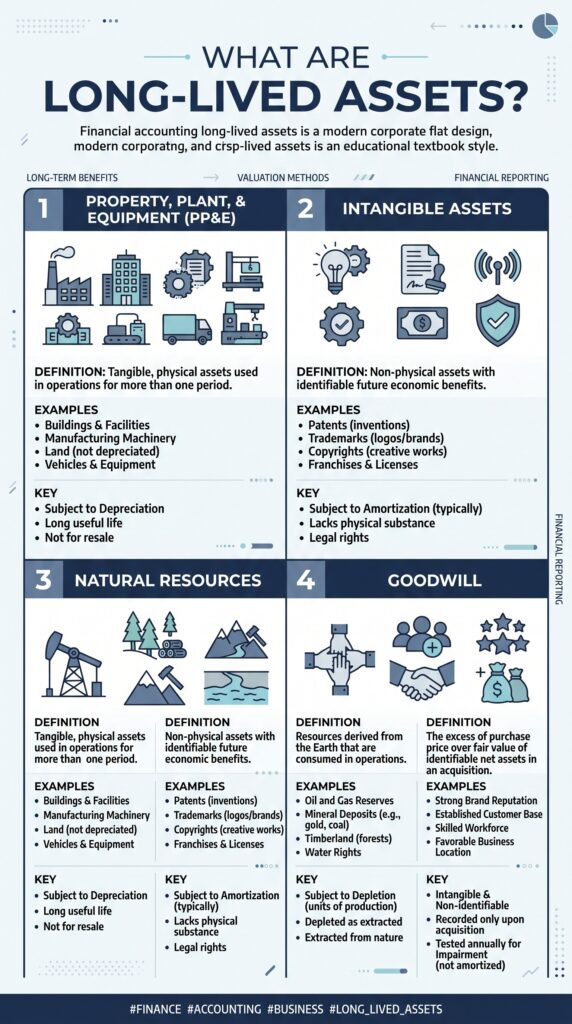
Long-lived assets (also called non-current assets or fixed assets) are resources that a business expects to use for more than one year or one operating cycle to generate economic benefits. They are not held primarily for resale in the ordinary course of business.
Examples include:
- Land, buildings, machinery, vehicles, furniture and fixtures.
- Intangible assets such as patents, trademarks, software, and licenses.
- Natural resources like oil and gas reserves, mines, and timberlands.
Why capitalize instead of expense?
Under accrual accounting and the matching principle, costs that provide benefits over multiple periods are capitalized as assets and then systematically expensed (via depreciation, amortization, or depletion) over their useful lives. This matches expenses with the revenues they help generate.
Illustrative scenario:
A manufacturing company buys a machine for Rs 1,000,000, pays Rs 50,000 for installation, and Rs 20,000 for testing before it is ready for use. The total capitalized cost of the machine will be Rs 1,070,000, not expensed immediately, because the machine will be used over several years.
2. Classification of Long-Lived Assets
| Category | Description | Examples | Depreciated / Amortized / Depleted? |
|---|---|---|---|
| Property, Plant, and Equipment (PPE) | Tangible assets used in operations | Land, buildings, machinery, vehicles, furniture | Yes (except land) |
| Intangible Assets | Non-physical assets with identifiable rights | Patents, trademarks, software, licenses | Yes if finite life; no if indefinite (impairment only) |
| Natural Resources | Depletable assets extracted from the earth | Oil and gas reserves, mines, timberlands | Yes, via depletion |
| Goodwill | Excess of purchase price over fair value of net assets in a business combination | Goodwill from acquisition | Not amortized; tested for impairment only |
3. Initial Recognition and Measurement
3.1 Cost Model (Initial Measurement)
Long-lived assets are initially measured at cost, which includes:
- Purchase price (net of discounts and rebates)
- Directly attributable costs necessary to bring the asset to the location and condition for its intended use, such as:
- Import duties and non-refundable taxes
- Site preparation, installation, and assembly costs
- Professional fees (legal, engineering)
- Testing costs (net of proceeds from trial runs)
Costs that are expensed, not capitalized:
- Routine repairs and maintenance
- Training costs for staff
- General administrative overheads not directly attributable
- Costs incurred after the asset is ready for use (unless they meet capitalization criteria for improvements)
3.2 Numerical Example: Capitalized Cost
A company purchases equipment:
- Invoice price: Rs 800,000
- Import duty (non-refundable): Rs 40,000
- Freight and insurance: Rs 15,000
- Installation and testing: Rs 25,000
- Staff training: Rs 10,000 (expensed)
- Annual maintenance contract: Rs 5,000 (expensed)
Capitalized cost = 800,000 + 40,000 + 15,000 + 25,000 = Rs 880,000
Training and maintenance are expensed in the period incurred.
Journal entry at acquisition:
4. Subsequent Measurement: Depreciation, Amortization, and Depletion
4.1 Key Concepts
- Useful life: The period over which the asset is expected to be available for use.
- Residual (salvage) value: Estimated amount obtainable at the end of useful life, after disposal costs.
- Depreciable amount: Cost (or revalued amount) minus residual value.
Depreciation (for PPE), amortization (for finite-life intangibles), and depletion (for natural resources) allocate the depreciable amount over the asset’s useful life in a systematic way.
Important: Land is not depreciated because it is assumed to have an indefinite useful life.
4.2 Common Depreciation Methods
1. Straight-line method
Annual Depreciation = (Cost − Residual Value) ÷ Useful Life (years)
2. Units-of-production (activity-based) method
Depreciation per Unit = (Cost − Residual Value) ÷ Total Estimated Units
Depreciation Expense = Depreciation per Unit × Units Produced in the Period
3. Declining-balance method (e.g., double-declining)
Depreciation Expense = Carrying Amount at Start of Year × Depreciation Rate
For double-declining: Rate = 2 ÷ Useful Life
4.3 Numerical Example: Straight-Line Depreciation
Using the equipment from Section 3.2:
- Capitalized cost: Rs 880,000
- Estimated residual value: Rs 80,000
- Useful life: 5 years
Depreciable amount = 880,000 − 80,000 = 800,000
Annual depreciation = 800,000 ÷ 5 = Rs 160,000
Annual journal entry:
After 3 years:
- Accumulated depreciation = 160,000 × 3 = 480,000
- Carrying amount = 880,000 − 480,000 = Rs 400,000
5. Impairment of Long-Lived Assets
Impairment occurs when the carrying amount of an asset (or asset group / CGU) exceeds the amount that can be recovered through use or sale.
5.1 Indicators of Impairment
Common indicators include:
- Significant decline in market value
- Adverse changes in technology, market, legal, or economic environment
- Evidence of obsolescence or physical damage
- Worse-than-expected cash flows or operating losses associated with the asset
When such indicators exist, an impairment test is required.
5.2 Assets Held for Use – US GAAP (ASC 360)
Under US GAAP, impairment testing for long-lived assets held for use follows a two-step process at the asset group level.
Step 1: Recoverability Test
Compare:
- Carrying amount of the asset group
- Sum of undiscounted future cash flows expected from the asset group
If:
- Undiscounted cash flows ≥ carrying amount → No impairment, stop.
- Undiscounted cash flows < carrying amount → Impairment indicated, proceed to Step 2.
Step 2: Measurement of Impairment Loss
Impairment loss = Carrying amount − Fair value of the asset group.
- Fair value may be based on market prices, discounted cash flows, or other valuation techniques.
- Once recognized, impairment losses on long-lived assets held for use cannot be reversed under US GAAP.
Numerical Example (US GAAP)
Titan Manufacturing has equipment:
- Cost: Rs 200,000
- Accumulated depreciation: Rs 80,000
- Carrying amount: Rs 120,000
Due to technological change:
- Estimated undiscounted future cash flows: Rs 90,000
- Estimated fair value: Rs 85,000
Step 1: Carrying amount (120,000) > Undiscounted cash flows (90,000) → Impairment indicated.
Step 2: Impairment loss = 120,000 − 85,000 = Rs 35,000
Journal entry:
New carrying amount = 120,000 − 35,000 = Rs 85,000 (new cost basis).
5.3 Assets Held for Use – IFRS (IAS 36)
Under IFRS, impairment testing uses a one-step model based on the recoverable amount.
Recoverable amount = Higher of:
- Fair value less costs of disposal (FVLCD)
- Value in use (VIU) – present value of estimated future cash flows from the asset or cash-generating unit (CGU), discounted at a pre-tax rate reflecting market assessments of time value of money and asset-specific risks.
If:
- Carrying amount > Recoverable amount → Impairment loss recognized.
- Carrying amount ≤ Recoverable amount → No impairment.
Impairment losses (except for goodwill) can be reversed in future periods if conditions improve.
Numerical Example (IFRS – Simplified VIU)
A CGU has:
- Carrying amount: Rs 4,200,000
- Pre-tax discount rate: 12%
- Forecast pre-tax cash flows (simplified):
Assume VIU calculation (present value of cash flows + terminal value) gives Rs 3,900,000, and FVLCD is Rs 3,700,000.
Recoverable amount = Higher of (3,900,000, 3,700,000) = 3,900,000
Carrying amount = 4,200,000
Impairment loss = 4,200,000 − 3,900,000 = Rs 300,000
Journal entry:
If in a later period, recoverable amount increases (and other IAS 36 conditions are met), part or all of this loss may be reversed (except for goodwill).
5.4 Assets Held for Sale
An asset (or disposal group) is classified as held for sale when:
- It is available for immediate sale in its present condition
- Sale is highly probable
- Management is committed to a plan to sell
- The asset is actively marketed at a reasonable price
- Sale is expected within one year (with limited exceptions)
Measurement:
- Measured at the lower of carrying amount and fair value less costs to sell.
- No depreciation is charged while classified as held for sale.
Example: Asset Held for Sale
Equipment:
- Carrying amount: Rs 500,000
- Fair value less costs to sell: Rs 420,000
Since 420,000 < 500,000, the asset is written down to 420,000.
Impairment loss = 500,000 − 420,000 = Rs 80,000
Journal entry:
6. Disposal and Derecognition
A long-lived asset is derecognized when:
- It is sold
- Retired or abandoned
- Exchanged
- Distributed to owners
Gain or loss on disposal is calculated as:
Gain/Loss = Proceeds from Disposal − Carrying Amount at Disposal
- If proceeds > carrying amount → Gain
- If proceeds < carrying amount → Loss
6.1 Numerical Example: Disposal with Gain
Recall the equipment from Section 4.3:
- Cost: Rs 880,000
- Accumulated depreciation after 3 years: Rs 480,000
- Carrying amount: Rs 400,000
Suppose it is sold for Rs 450,000.
Gain on disposal = 450,000 − 400,000 = Rs 50,000
Journal entries:
(Alternatively, some present this in two entries: one to remove asset and accumulated depreciation to a disposal account, and another to record cash and gain/loss.)
6.2 Disposal with Loss
If the same asset is sold for Rs 350,000:
Loss on disposal = 350,000 − 400,000 = −Rs 50,000
Journal entries:
7. Presentation and Disclosure
7.1 Balance Sheet Presentation
Long-lived assets are presented under non-current assets, often as:
- Property, Plant, and Equipment (net of accumulated depreciation and impairment)
- Intangible Assets (net of accumulated amortization and impairment)
- Goodwill (separately disclosed)
Typical format:

Post navigation
Next Post