

Class Notes: Manufacturing Costs
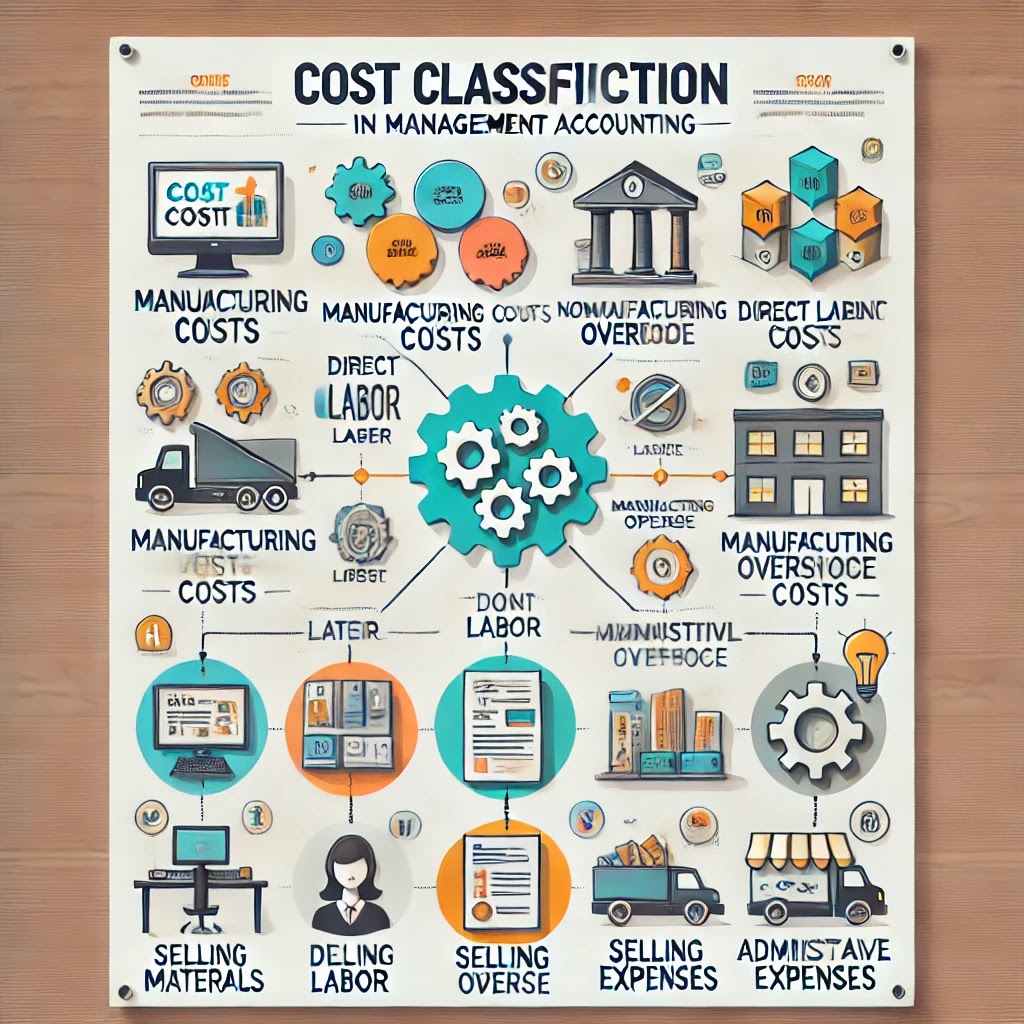
Manufacturing companies classify costs into three broad categories:
1. Direct Materials
- Definition:
Materials that are used in the final product. - Raw
Materials: Can be unprocessed natural resources or
finished products from another company (e.g., plastics from Du Pont used
in HP computers). - Direct
Materials: Become an integral part of the product and can
be traced conveniently (e.g., aircraft seats in Airbus, motors in
Panasonic DVD players). - Indirect
Materials: Minor items not worth tracing individually
(e.g., solder in Sony TVs, glue in Ethan Allen chairs). These are included
in Manufacturing Overhead.
2. Direct Labor
- Definition:
Labor costs that can be physically and conveniently traced to products. - Also
called: Touch labor (workers directly involved in
production). - Examples:
Assembly-line workers (Toyota), carpenters (KB Home), electricians
(Bombardier Learjet). - Indirect
Labor: Labor costs that cannot be traced to specific
products (e.g., janitors, supervisors, materials handlers, security
guards). These costs are included in Manufacturing
Overhead.
3. Manufacturing Overhead
- Definition:
All manufacturing costs except direct materials and direct labor. - Includes:
- Indirect
materials (e.g., solder, glue) - Indirect
labor (e.g., janitors, supervisors) - Other
costs (e.g., maintenance, repairs, heat, light, property
taxes, depreciation, insurance on production facilities). - Exclusions:
Selling and administrative costs (e.g., office utilities, insurance on
non-manufacturing facilities). - Alternative
Names: Indirect manufacturing cost, factory overhead,
factory burden.
Key Takeaways
- Direct
materials and direct labor are easily traceable
to the final product. - Indirect
materials and indirect labor are included in manufacturing overhead. - Manufacturing
overhead consists of all other costs related to factory
operations but excludes selling and administrative
expenses.
4. Nonmanufacturing Costs
Nonmanufacturing costs are divided into two main categories:
a. Selling Costs
·
Definition: Costs incurred to
secure customer orders and deliver the product.
·
Also called: Order-getting and
order-filling costs.
·
Examples: Advertising,
shipping, sales travel, sales commissions, sales salaries, and costs of
finished goods warehouses.
b. Administrative Costs
·
Definition: Costs associated
with general management rather than manufacturing or selling.
·
Examples: Executive
compensation, general accounting, secretarial expenses, public relations, and
similar general administration costs.
·
Alternative Names for Nonmanufacturing
Costs: Selling, general, and administrative (SG&A) costs or simply
selling and administrative costs.
Product Costs vs. Period Costs
Product Costs vs. Period Costs: Understanding the Matching
Principle
In addition to
classifying costs as manufacturing or nonmanufacturing, another fundamental way
to categorize costs is as product costs or period costs. Understanding this
distinction requires an examination of the matching principle from financial
accounting.
The Matching Principle
The matching principle
is an essential concept in accrual accounting, ensuring that expenses are
recognized in the same period as the revenues they help generate. For instance,
when a company prepays for liability insurance covering two years, it does not
expense the entire amount in the year of payment. Instead, the cost is
allocated evenly over the two years because both years benefit from the
insurance coverage. The portion of the payment that has not yet been expensed
is recorded as an asset (prepaid insurance) on the balance sheet until it is
recognized as an expense in the appropriate period.
a. Product Costs
·
Definition: All costs incurred
to acquire or manufacture a product.
·
Includes: Direct materials,
direct labor, and manufacturing overhead.
·
Accounting Treatment:
o
Initially recorded as inventory on the balance
sheet.
o
Expensed as cost of goods sold (COGS)
when the product is sold.
o
Also called inventorial costs.
b. Period Costs
·
Definition: Costs that are not
included in product costs and are expensed in the period they are incurred.
·
Includes: Selling and
administrative expenses (e.g., sales commissions, advertising, executive
salaries, public relations, office rent).
·
Accounting Treatment:
o
Expensed directly on the income statement when
incurred.
o
Not included in the cost of goods.
·
Key Concept: The matching
principle in accounting ensures that costs are recognized in the same
period as the revenue they help generate. This means that costs incurred to
produce inventory are only expensed when the inventory is sold, whereas period
costs are expensed as they occur.
·
Product costs are capitalized as
inventory until sold, while period costs are expensed in the
period incurred.
Example of a Period Cost: Advertising Expense
Scenario:
A retail company, Fashion Trends Inc., launches a
nationwide advertising campaign to promote its new clothing line. The company spends
$500,000 on television commercials, online ads, and billboards
in January 2024 to drive customer traffic and increase sales
throughout the year.
Explanation:
The $500,000 advertising expense is a period cost
because:
- It
is not directly tied to the production of goods. Unlike
product costs (such as fabric or factory labor), advertising expenses
support sales rather than manufacturing. - It
is expensed in the period it is incurred. Regardless of
when the increased sales occur, the full $500,000 is
recorded as an expense in January 2024, when the
advertisement was run. - It
appears on the income statement under operating expenses.
Advertising costs fall under selling, general, and
administrative expenses (SG&A) rather than inventory
or cost of goods sold (COGS).
Accounting Treatment (Journal Entry):
When the company incurs the advertising expense in January:
📌 Journal Entry (January 2024):
Dr. Advertising Expense $500,000 Cr. Cash (or Accounts Payable) $500,000 - Debit
(Dr.) Advertising Expense to recognize the cost. - Credit
(Cr.) Cash (if paid immediately) or Accounts Payable (if paid later).
Key Takeaways:
✅ Period costs are always expensed in the
period they are incurred, regardless of revenue generation.
✅ They do not become part of inventory or
cost of goods sold (COGS).
✅ Other examples include rent, executive
salaries, and office supplies.
Prime Cost and Conversion Cost
Two additional cost categories are commonly used in manufacturing:
a. Prime Cost
·
Definition: The sum of direct
materials cost and direct labor cost.
·
Formula:
b. Conversion Cost
·
Definition: The sum of direct
labor cost and manufacturing overhead cost.
·
Formula:
·
Explanation: The term
“conversion cost” is used because these costs are incurred to convert
raw materials into finished products.
MCQs on Manufacturing and Nonmanufacturing Costs
1. Which of the following is NOT a broad category of
manufacturing costs?
a) Direct materials
b) Direct labor
c) Administrative costs
d) Manufacturing overhead
Answer: c) Administrative costs
2. Which of the following is an example of direct material?
a) Lubricant used in machines
b) Glue used in furniture assembly
c) Steel used in car manufacturing
d) Cleaning supplies for the factory
Answer: c) Steel used in car manufacturing
3. Indirect materials are included in which cost category?
a) Direct labor
b) Manufacturing overhead
c) Administrative expenses
d) Selling expenses
Answer: b) Manufacturing overhead
4. What is another term for direct labor?
a) Office labor
b) Touch labor
c) Indirect labor
d) Executive labor
Answer: b) Touch labor
5. Which of the following is an example of indirect labor?
a) Assembly-line workers at Toyota
b) Carpenters at a home-building company
c) Janitors in a factory
d) Electricians installing aircraft equipment
Answer: c) Janitors in a factory
MCQs on Nonmanufacturing Costs
6. Selling costs include which of the following?
a) Depreciation on factory machinery
b) Advertising expenses
c) Raw material costs
d) Factory maintenance costs
Answer: b) Advertising expenses
7. Which of the following is an administrative cost?
a) Depreciation on factory equipment
b) Insurance for production facilities
c) Executive salaries
d) Wages of assembly-line workers
Answer: c) Executive salaries
8. What is another name for nonmanufacturing costs?
a) Prime costs
b) Inventoriable costs
c) Selling, General, and Administrative (SG&A) costs
d) Conversion costs
Answer: c) Selling, General, and Administrative (SG&A)
costs
MCQs on Product Costs vs. Period Costs
9. Which of the following is a product cost?
a) Sales commissions
b) Factory maintenance
c) Advertising costs
d) Office rent
Answer: b) Factory maintenance
10. When are product costs expensed on the income statement?
a) When they are incurred
b) When the related product is sold
c) At the beginning of the accounting period
d) When cash is paid for the expenses
Answer: b) When the related product is sold
11. What is the alternative name for product costs?
a) Inventoriable costs
b) Period costs
c) SG&A costs
d) Nonmanufacturing costs
Answer: a) Inventoriable costs
12. Period costs are expensed in which period?
a) When the product is sold
b) Over multiple periods
c) In the period they are incurred
d) When raw materials are purchased
Answer: c) In the period they are incurred
MCQs on Prime Cost and Conversion Cost
13. Which of the following costs are included in prime cost?
a) Direct materials and manufacturing overhead
b) Direct labor and manufacturing overhead
c) Direct materials and direct labor
d) Direct labor and administrative costs
Answer: c) Direct materials and direct labor
14. What is the formula for conversion cost?
a) Direct materials + Direct labor
b) Direct labor + Manufacturing overhead
c) Direct materials + Manufacturing overhead
d) Selling costs + Administrative costs
Answer: b) Direct labor + Manufacturing overhead
15. Why is the term “conversion cost” used?
a) It represents costs required to convert raw materials into finished
products
b) It includes all costs incurred during sales
c) It only applies to service industries
d) It refers to changing fixed costs into variable costs
Answer: a) It represents costs required to convert raw
materials into finished products
EXERCISE 2–1 Classifying
Manufacturing Costs [LO1] Your Boat, Inc., assembles custom sailboats from
components supplied by various manufacturers. The company is very small and its
assembly shop and retail sales store are housed in a Gig Harbor, Washington,
boathouse. Some of the costs that are incurred at the company are listed below.
Required: For each cost, indicate whether it would most likely be classified as
direct labor, direct materials, manufacturing overhead, selling, or
administrative cost. 1. The wages of employees who build the sailboats. 2. The
cost of advertising in the local newspapers. 3. The cost of an aluminum mast
installed in a sailboat. 4. The wages of the assembly shop’s supervisor. 5.
Rent on the boathouse. 6. The wages of the company’s bookkeeper. 7. Sales
commissions paid to the company’s salespeople. 8. Depreciation on power tools
Here is the classification of each
cost:
- The wages of employees who build the sailboats → Direct Labor
- The cost of advertising in the local newspapers → Selling Cost
- The cost of an aluminum mast installed in a sailboat → Direct Materials
- The wages of the assembly shop’s supervisor → Manufacturing Overhead
- Rent on the boathouse
→ Manufacturing Overhead (if used for production); Administrative
Cost (if used for general operations) - The wages of the company’s bookkeeper → Administrative Cost
- Sales commissions paid to the company’s salespeople → Selling Cost
- Depreciation on power tools → Manufacturing Overhead