
🍋 1. Independent, Dependent, and Mutually Exclusive Projects
✅
Independent Project
You can build a new lemonade
stand at your house and also buy a new juicer. Doing one
doesn’t affect the other.
Example:
- Build a stand: Costs $100, makes $150.
- Buy a juicer: Costs $50, makes $70. You can do both.
🔗 Dependent Project
You want to buy a machine,
but it only works if you also build a bigger table. One project depends
on another.
Example:
- Machine: Costs $200, but only works if you spend $100
building a larger table.
🚫 Mutually Exclusive Project
You can either buy a bike
or a scooter, not both.
Example:
- Bike: Costs $150, earns $50/month.
- Scooter: Costs $150, earns $70/month. You must choose one.
📊 2. Ranking Conflicts: IRR vs. NPV vs. PI
These are three ways to judge
projects:
- NPV (Net Present Value): How much money you’ll make in today’s value.
- IRR (Internal Rate of Return): The rate at which you earn money.
- PI (Profitability Index): Profit per $1 invested.
Sometimes, they rank projects
differently.
🧮
A. Different Sizes of Investment (Scale Difference)
Project S (Small):
- Invest $100, get $400 in 2 years.
- IRR = 100%, NPV = $231, PI = 3.31
Project L (Large):
- Invest $100,000, get $156,250 in 2 years.
- IRR = 25%, NPV = $29,132, PI = 1.29
👉 IRR and PI prefer S (because % is higher), but NPV
prefers L (because you earn more total dollars).
🔄 B. Different Cash Flow Patterns
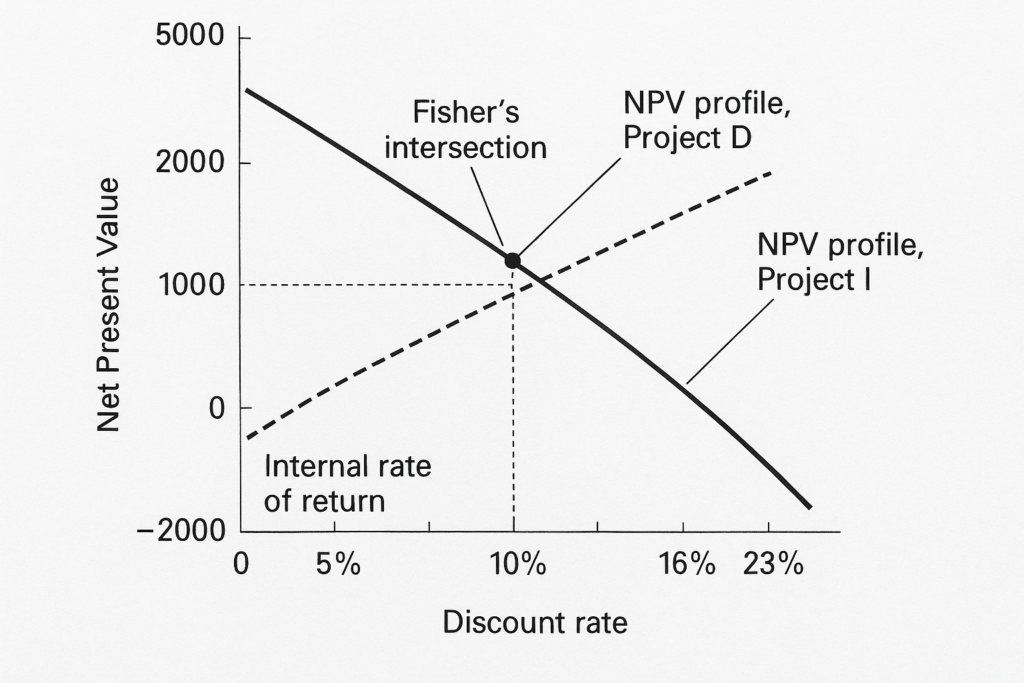
Project D (Decreasing cash flow):
- Year 0: –$1,200
- Year 1: $1,000
- Year 2: $500
- Year 3: $100
IRR = 23%
Project I (Increasing cash flow):
- Year 0: –$1,200
- Year 1: $100
- Year 2: $600
- Year 3: $1,080
IRR = 17%
👉 When interest is more than 10%, choose D;
👉 When interest is less than 10%, choose I.
📌 This crossing point is called Fisher’s Rate of
Intersection.

⏳
C. Different Project Lives
Project X (Lives 3 years):
- Year 0: –$1,000
- Year 3: $3,375
IRR = 50%, NPV = $1,536, PI = 2.54
Project Y (Lives 1 year):
- Year 0: –$1,000
- Year 1: $2,000
IRR = 100%, NPV = $818, PI = 1.82
👉 Y looks better if you like fast cash, but X earns more
total value if you wait.
✅ NPV is better for decision-making when lives differ.
🔁 3. Multiple IRRs
When a project has cash flows
changing signs more than once (like –, +, +, –), there may be more than
one IRR, which confuses the decision.
Example:
- Year 0: –$500
- Year 1: +$1,000
- Year 2: –$600
Here the cash flow goes from negative to positive, and then back to
negative.
✅ Solution: Use NPV method instead of IRR.
🧠
Final Lesson
Even though a high return (like
100%) sounds amazing, always ask:
- How much money in total will I make?
- How long will it take to earn that?
- Can I only pick one option?
And when in doubt—trust the NPV
method, because it tells you how much real value you’re adding to your
piggy bank today! 🐷💰
1. Which of the following best describes a mutually exclusive
project?
A. A project that can be accepted with any other
project
B. A project whose acceptance precludes the acceptance of others
C. A project that must be accepted if another project is accepted
D. A project with multiple IRRs
✅ Correct Answer: B
2. Which
project evaluation method is most appropriate when projects differ in scale?
A. Internal Rate of Return (IRR)
B. Profitability Index (PI)
C. Net Present Value (NPV)
D. Payback Period
✅ Correct Answer: C
3. What is
the main issue when two mutually exclusive projects show different rankings
under IRR and NPV methods?
A. Project costs are equal
B. Projects are independent
C. Differences in project characteristics like scale, timing, or life
D. Inflation is constant
✅ Correct Answer: C
4. If
Project A has a higher IRR but lower NPV than Project B, which project should
generally be chosen?
A. Project A
B. Project B
C. Both
D. Cannot be determined
✅ Correct Answer: B
5. The
Fisher’s Intersection Rate is the discount rate at which:
A. Two projects have the same IRR
B. The NPV of two projects becomes zero
C. The IRRs of multiple projects equal the cost of capital
D. Two projects have the same NPV
✅ Correct Answer: D
6.
Which of the following would not typically cause ranking conflicts among IRR,
NPV, and PI methods?
A. Equal cash flows
B. Different project lives
C. Differences in investment scale
D. Differences in cash flow timing
✅ Correct Answer: A
7. A
project that requires another project to be accepted before it can be
undertaken is called:
A. Independent project
B. Mutually exclusive project
C. Dependent (or contingent) project
D. Replacement project
✅ Correct Answer: C
8. What
is the IRR of a project with an initial outlay of $1,200 and returns of $1,000,
$500, and $100 over 3 years?
A. 15%
B. 17%
C. 23%
D. 25%
✅ Correct Answer: C
(Based on the Project D
example in your provided material.)
9. A
project with cash inflows increasing over time would most likely have:
A. Lower NPV at higher discount rates
B. A constant IRR
C. A lower IRR than a project with early cash inflows
D. No ranking conflicts with other methods
✅ Correct Answer: C
10.
When comparing projects with different lives, the best way to rank them is by:
A. IRR only
B. PI only
C. NPV using terminal value approach
D. Payback Period
✅ Correct Answer: C
——————————————————————————————————————————————
Here are numerical questions
(with answers) — two for each topic — based on the concepts
discussed: Dependency, Mutual Exclusion, Ranking Problem, Scale, Cash Flow
Pattern, Project Life, and Fisher’s Intersection.
🟩
A. Dependency
Q1.
Project A costs $5,000 and yields a
return of $7,000. Project B costs $4,000 and yields a return of $6,000. If
Project B can only be undertaken if Project A is accepted, what is the combined
NPV at a discount rate of 10%?
Solution:
- PV (A) = 7,000 / (1.10) = 6,364
- PV (B) = 6,000 / (1.10) = 5,455
- Total PV = 11,819
- Total cost = 5,000 + 4,000 = 9,000
- NPV = 11,819 – 9,000 = $2,819
✅ Answer: $2,819
Q2.
Project X requires Project Y to be
undertaken first. If Project Y has an NPV of –$500 and Project X has an NPV of
$2,000, should both be accepted?
✅ Answer: Yes, because the combined NPV = $2,000 –
$500 = $1,500 > 0.
🟩
B. Mutual Exclusion
Q3.
Project A: Initial Cost = $10,000,
NPV = $2,000
Project B: Initial Cost = $12,000, NPV = $2,500
If the two are mutually exclusive, which one should be selected?
✅ Answer: Project B (higher NPV of $2,500)
Q4.
You can undertake only one of the
following:
- Project P: Cost = $8,000; PV of inflows = $10,000
- Project Q: Cost = $9,000; PV of inflows = $11,000
Which project should be selected?
- NPV (P) = 10,000 – 8,000 = $2,000
- NPV (Q) = 11,000 – 9,000 = $2,000
✅ Answer: Both have the same NPV. Choose based on
other factors (e.g., risk or scale).
🟩
C. Ranking Problems
Q5.
Project A: Cost = $10,000; Cash
inflow = $13,000 in 1 year
Project B: Cost = $10,000; Cash inflow = $17,000 in 3 years
Discount rate = 10%
Find the NPV of both and identify
ranking conflict.
- NPV (A) = 13,000 / 1.1 – 10,000 = $1,818
- NPV (B) = 17,000 / (1.1)^3 – 10,000 = $12,764 – 10,000
= $2,764
✅ Answer: NPV ranks B higher, but IRR (for A = 30%) is
higher than B → ranking conflict exists.
Q6.
Two mutually exclusive projects have
the following cash flows:
|
Year |
Project |
Project |
|
0 |
–$5,000 |
–$5,000 |
|
1 |
$6,000 |
$3,000 |
|
2 |
$0 |
$4,000 |
At 10% discount rate, which is
preferred?
- NPV (X) = 6,000 / 1.1 – 5,000 = $454.55
- NPV (Y) = 3,000 / 1.1 + 4,000 / (1.1)^2 – 5,000 ≈
2,727.27 + 3,305.79 – 5,000 ≈ $1,033
✅ Answer: Project Y (higher NPV despite different
timing)
🟩
D. Scale
Q7.
Project A: Cost = $100,000, NPV =
$20,000
Project B: Cost = $50,000, NPV = $15,000
Which has the higher profitability
index (PI)?
- PI (A) = (100,000 + 20,000)/100,000 = 1.2
- PI (B) = (50,000 + 15,000)/50,000 = 1.3
✅ Answer: Project B (higher PI despite smaller NPV)
Q8.
You are choosing between:
- Project X: Cost = $200,000; NPV = $30,000
- Project Y: Cost = $100,000; NPV = $25,000
Which project should be selected if
funds are limited?
✅ Answer: Project Y (higher NPV per dollar invested or
higher PI)
🟩
E. Cash Flow Patterns
Q9.
Project A: $10,000 invested, cash
flows = $2,000/year for 7 years
Project B: $10,000 invested, cash flows = $4,000 in Year 1, $1,000/year for 6
years
Which has a more even cash flow
pattern?
✅ Answer: Project A (uniform inflows)
Q10.
Given two projects:
- A: Increasing cash flows
- B: Declining cash flows
Which is likely to have a higher
IRR?
✅ Answer: Project B (more cash in early years)
🟩
F. Project Life
Q11.
Project A: 3-year life, NPV = $5,000
Project B: 6-year life, NPV = $6,000
Which has a higher equivalent annual
annuity (EAA) at 10%?
- EAA A = 5,000 / PVIFA(10%, 3) = 5,000 / 2.487 = $2,010
- EAA B = 6,000 / PVIFA(10%, 6) = 6,000 / 4.355 = $1,378
✅ Answer: Project A
Q12.
A 4-year project has an NPV of
$4,000. If the discount rate is 8%, what is its EAA?
- PVIFA(8%, 4) = 3.312
- EAA = 4,000 / 3.312 = $1,207.37
✅ Answer: $1,207.37
🟩
G. Fisher’s Intersection
Q13.
Project A NPV = 0 at 16%
Project B NPV = 0 at 18%
Their NPV profiles intersect at 13%. What does this rate represent?
✅ Answer: The Fisher’s Intersection Rate — the rate at
which both projects have the same NPV.
Q14.
Given the NPV profiles of Projects A
and B intersect at 11%, and the cost of capital is 9%, which project should be
chosen?
- Below 11%: Project with higher NPV is preferred
- At 9%: If A has higher NPV at 9%, select A
✅ Answer: Choose the project with the higher NPV at
9%, regardless of IRR.