
🎓 Modigliani and Miller (MM) Theory
of Capital Structure

📌 Introduction: What is Capital Structure?
Imagine you’re starting a lemonade
stand. You need money to buy lemons, sugar, cups, and a stand. You can get this
money in two main ways:
- Borrow it (debt)
– like taking a loan from your parents. - Use your own savings (equity) – like using your piggy bank money.
How much money you borrow vs. how
much of your own you use is your capital structure.
🧠
Meet the Brains Behind the Theory
In the 1950s, two smart economists, Franco
Modigliani and Merton Miller, asked a big question:
“Does it matter how a company
raises money – through debt or equity – when it comes to the value of the
company?”
And guess what? Their answer changed
how businesses think about financing forever.
🧾
MM Theory – The Two Big Ideas
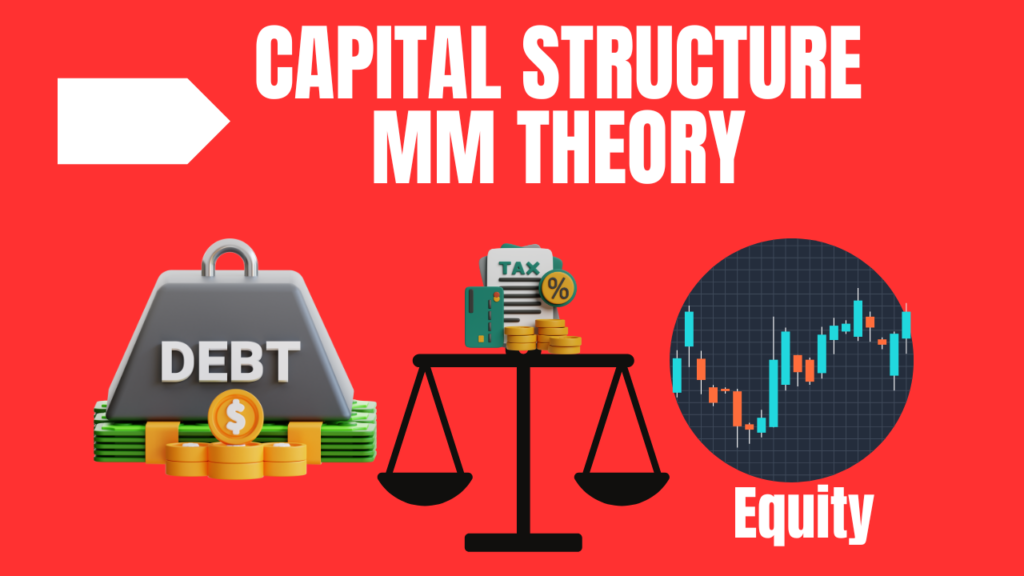
💡 Proposition I: Capital Structure Doesn’t Affect Value (No
Taxes)
Imagine two companies:
- Company A uses only its own money (equity).
- Company B borrows money and also uses equity (a mix of
debt and equity).
MM Proposition I says: Both companies will be worth the same if:
- There are no taxes,
- Everyone has the same information,
- There are no bankruptcy costs.
🔍 Why?
Because investors can create their own “home-made” leverage. If one
company borrows, you as an investor can do the same and get similar returns.
📊 Example:
You invest $100 in Company A (equity
only).
Your friend invests $50 in equity and borrows $50 to invest in Company B.
In a perfect world (no taxes or
risk), you both end up with the same profit.
💡 Proposition II: Risk and Return Are Connected
This part says:
“The more debt a company uses,
the riskier it becomes for equity holders—and they’ll demand more return.”
🔺 More Debt = More Risk
When a company borrows more, paying interest becomes a must. If profits go
down, there might not be enough to pay both interest and shareholders.
So, shareholders say: “Hey,
you’re taking on more debt, so I want a bigger reward (return) for the risk I’m
taking!”
📈 Example:
- Company A (no debt) has shareholders expecting a 10%
return. - Company B (with debt) has shareholders expecting 15%
because it’s riskier.
🧮
When You Add Taxes: MM Theory with Tax Shield
Real life isn’t perfect. Companies
pay taxes—but there’s a twist.
🧾
Interest on debt is tax-deductible.
That means borrowing actually helps
a company save money on taxes.
So Modigliani and Miller updated
their idea:
“In the real world with taxes,
using more debt can increase the value of a company.”
✅ Why? Because interest on debt reduces the taxable income.
Less tax = more money left for the owners.
📊 Example:
Company X earns $100,000 and pays 30% tax = $30,000 in taxes.
But if it pays $20,000 in interest,
it only pays tax on $80,000:
- New tax = $24,000.
- That’s $6,000 saved thanks to debt.
🧱
Real-World Limits: Why Not Use All Debt?
If debt saves money on taxes, why
don’t companies borrow all the money they can?
Because of three big risks:
- Bankruptcy Risk
– Too much debt can lead to default. - Agency Costs
– Managers might make bad decisions with borrowed money. - Loss of Flexibility
– Heavy debt can limit future options.
📝 Summary of MM Theory
|
Assumptions |
Implications |
|
No taxes, no transaction costs |
Capital structure does not |
|
Perfect information and no |
Investors can create personal |
With Taxes:
- Debt becomes attractive because of tax savings.
- More debt can increase firm value, up to a point.
🔄 Real-Life Application
- Startups:
Often avoid debt early, because they are risky. - Large Corporations:
Balance debt and equity to maximize value while managing risk. - Banks and Airlines:
Often use more debt, but must manage carefully to avoid collapse.
🧠
In Simple Words:
Modigliani and Miller taught us that
how you finance a company is important, but only when the real world
is considered — like taxes, bankruptcy, and market imperfections.
📚 References (APA Style)
- Modigliani, F., & Miller, M. H. (1958). The cost
of capital, corporation finance and the theory of investment. American
Economic Review, 48(3), 261–297. - Modigliani, F., & Miller, M. H. (1963). Corporate
income taxes and the cost of capital: A correction. American Economic
Review, 53(3), 433–443. - Ross, S. A., Westerfield, R., & Jaffe, J. (2019). Corporate
finance (12th ed.). McGraw-Hill Education.
#MMTheory, #CapitalStructure, #FinanceBasics, #ModiglianiMiller, #CorporateFinance, #FinancialTheory, #ELI10Finance, #DebtVsEquity, #FinanceLecture, #InvestmentDecisions, #BusinessFinance, #CapitalStructureTheory, #FinanceEducation, #FinancialManagement, #FinancialLeverage, #CostOfCapital, #FinanceSimplified, #EconomicsExplained, #MMProposition, #OptimalCapitalStructure, #ModiglianiAndMillerTheoryOfCapitalStructure, #ModiglianiAndMillerTheoryPDF, #ModiglianiAndMillerTheoryOfCapitalStructure, #ModiglianiAndMillerTheoryWithTax, #ModiglianiAndMiller1958, #ModiglianiAndMillerFormula, #ModiglianiAndMillerProposition1And2, #ModiglianiAndMillerProposition2, #ModiglianiMillerProposition1