

1.
What Are Standard Costs?
Standard
costs serve as benchmarks for measuring operational performance. They
are common across industries, just like doctors use health standards or
engineers follow building codes. In managerial accounting, standards are
typically established for both quantity and price of inputs
(Garrison, Noreen, & Brewer, 2021).
- Quantity standards
define how much material or labor is expected. - Price standards
specify the expected cost of that material or labor.
2.
Why Are Standard Costs Important?
Standard
costs are used to compare expected outcomes to actual results. The
difference between the two is called a variance. Managers investigate
these variances to maintain control and improve efficiency. This method is
known as management by exception (Garrison et al., 2021).
🔍 Example:
If your car doesn’t start when you turn the key, it deviates from your expected
standard. Investigating the problem (variance) helps prevent future
failure—just as variance analysis identifies and addresses operational issues.
3.
The Variance Analysis Cycle
The variance analysis cycle includes
the following steps:
- Prepare standard cost performance reports.
- Identify variances (differences between actual and
expected). - Investigate significant variances.
- Take corrective action.
- Implement improvements and repeat the cycle (Drury,
2018).
🎯 Focus is on continuous improvement, not blame.
4.
Who Uses Standard Costs?
Standard costs are applied across
various sectors:
- Manufacturing:
Standards for raw materials, labor, and overhead. - Service industries:
Auto repair shops have time standards for tasks. - Fast food:
McDonald’s uses exact meat quantity and cost standards. - Healthcare:
Hospitals standardize costs for food, cleaning, and medical services
(Horngren, Datar, & Rajan, 2015).
📄 Standard Cost Card: A document that lists the
quantity and cost standards for producing one unit of a product.
5.
Types of Standards
There are two main types of
standards (Garrison et al., 2021):
- Ideal Standards:
- Assumes perfect efficiency, no machine failures, and
full capacity. - Rarely achievable, but motivational for continual
improvement. - Practical Standards:
- Allow for expected inefficiencies such as waste or
delays. - More realistic and widely used.
🧠
Key Takeaways
- Standard costing enables better planning, control,
and performance evaluation. - Variance analysis helps in problem detection and
correction. - It promotes efficiency and accountability across
industries.
📚 References (APA 7th Edition)
- Drury, C. (2018). Management and Cost Accounting
(10th ed.). Cengage Learning. - Garrison, R. H., Noreen, E. W., & Brewer, P. C.
(2021). Managerial Accounting (17th ed.). McGraw-Hill Education. - Horngren, C. T., Datar, S. M., & Rajan, M. V.
(2015). Cost Accounting: A Managerial Emphasis (15th ed.). Pearson.
Setting Direct Material Standards
he only significant raw material used is pewter ingots. The standard price per unit for direct materials should reflect the final, delivered cost of the materials. After consulting with the purchasing department, the standard price of pewter was set at $4.00 per pound. The standard quantity per unit for direct materials should reflect the amount of material required for each unit of finished product, including an allowance for unavoidable waste. Based on input from the production department, the quantity standard for pewter was set at 3.0 pounds per pair of bookends. The standard cost of material per unit of the finished product is therefore:
3.0 pounds per unit × $4.00 per pound = $12.00 per unit
This $12.00 cost is recorded on the product’s standard cost card.
Setting Direct Labor Standards
Direct labor price and quantity standards are usually expressed in terms of a labor rate and labor-hours. The standard rate per hour should include hourly wages, employment taxes, and fringe benefits. Using wage records and in consultation with the production manager, Terry Sherman determined the standard rate to be $22.00 per direct labor-hour.
The standard direct labor time required to complete a unit of product is often the most difficult standard to determine. Time and motion studies or published movement tables may be used, including allowances for breaks, personal time, cleanup, and machine downtime (Drury, 2018).
0.50 direct labor-hours × $22.00 per hour = $11.00 per unit
This $11.00 per unit labor cost is included on the standard cost card (Garrison et al., 2021).
Setting Variable Manufacturing Overhead Standards
Like direct labor, variable manufacturing overhead standards use rate and hours. At Colonial Pewter, the variable portion of the predetermined overhead rate is $6.00 per direct labor-hour. Terry computed the standard variable manufacturing overhead per unit as:
0.50 hours × $6.00 = $3.00 per unit
Thus, the total standard cost per unit is:
$12.00 (Materials) + $11.00 (Labor) + $3.00 (Overhead) = $26.00 per unit
(Garrison et al., 2021)
Using Standards in Flexible Budgets
These standards are used to create flexible budgets that help analyze activity and spending variances. For example, in June:
-
Planned output: 2,100 units
-
Actual output: 2,000 units
-
Actual material cost: $24,700
-
Actual labor cost: $22,680
-
Actual overhead cost: $7,140
A performance report reveals whether variances are favorable (F) or unfavorable (U). For instance, a $700 unfavorable materials variance may be due to excessive usage or higher-than-expected prices (Horngren, Datar, & Rajan, 2015).
Table: Flexible Budget Performance Report—Manufacturing Costs Only
|
Manufacturing Cost Item |
Planned Budget (2,100 |
Activity Variance |
Flexible Budget (2,000 |
Spending Variance |
Actual Results (2,000 |
|
Direct Materials |
$25,200 |
$1,200 F |
$24,000 |
$700 U |
$24,700 |
|
Direct Labor ($11.00/unit) |
$23,100 |
$1,100 F |
$22,000 |
$680 U |
$22,680 |
|
Variable Manufacturing |
$6,300 |
$300 F |
$6,000 |
$1,140 U |
$7,140 |
|
Total Manufacturing Costs |
$54,600 |
$2,600 F |
$52,000 |
$2,520 U |
$54,520 |
F = Favorable, U = Unfavorable
A
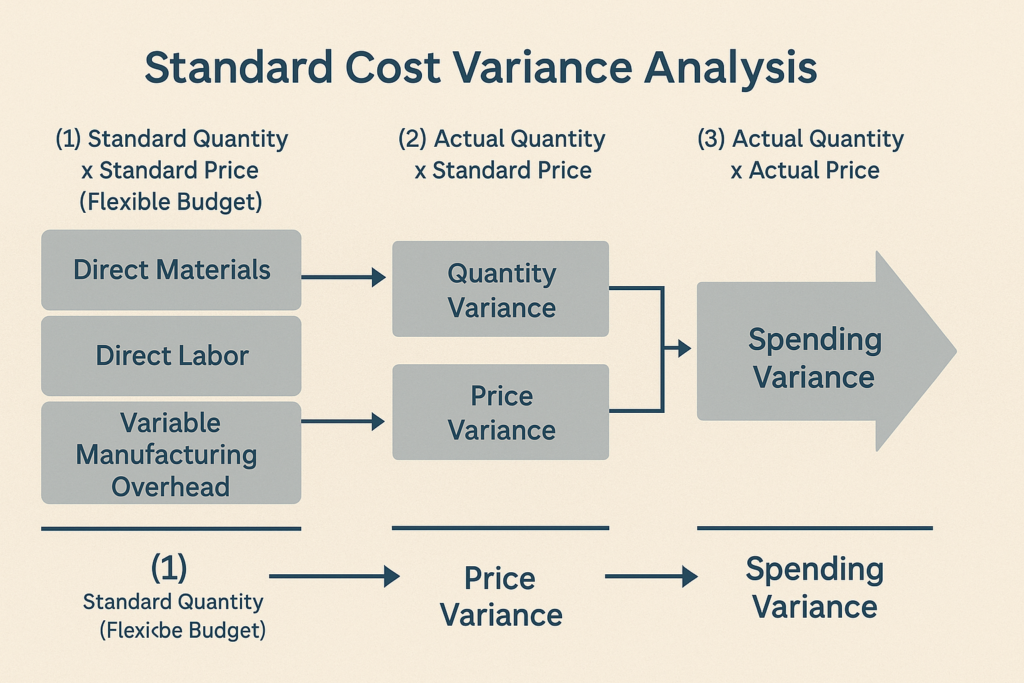
General Model for Standard Cost Variance Analysis
The fundamental purpose of standard
cost variance analysis is to break down spending variances from the flexible
budget into two elements:
- One caused by how much of the input was used
(quantity variance) - One caused by the price paid for the input
(price variance)
Definitions:
- A quantity variance is the difference between
the actual quantity used and the standard quantity allowed
for actual output, multiplied by the standard price. - A price variance is the difference between the actual
price paid and the standard price, multiplied by the actual
quantity purchased.
Importance
of Separating Standards:
Standards are separated into quantity
and price because:
- These variances usually have different causes
- They are typically controlled by different managers:
- The purchasing manager is responsible for input
prices - The production manager is responsible for input
usage
This separation helps assign
responsibility appropriately and facilitates timely and accurate performance
reports.
Table:
General Model for Standard Cost Variance Analysis (Exhibit 10–4)
This model shows how to break the spending
variance into a quantity variance and a price variance.
|
Cost |
Standard |
Actual |
Actual |
Quantity |
Price |
Spending |
|
Direct Materials |
$24,000 |
$24,600 |
$24,700 |
$600 U |
$100 U |
$700 U |
|
Direct Labor |
$22,000 |
$22,320 |
$22,680 |
$320 U |
$360 U |
$680 U |
|
Variable Manufacturing Overhead |
$6,000 |
$6,720 |
$7,140 |
$720 U |
$420 U |
$1,140 U |
U
= Unfavorable
F = Favorable (none in this case)
Key
Points:
- Each variable cost element (materials, labor, overhead) can have both a quantity
and a price (rate) variance. - The formulas for quantity and price variance are
consistent across different cost elements. - The standard quantity allowed is calculated as:
Standard Quantity Allowed=Actual Output Units×Standard Input per Unittext{Standard
Quantity Allowed} = text{Actual Output Units} times text{Standard Input per
Unit}
This gives the expected input usage
under efficient conditions and serves as a benchmark for variance analysis.
Material Quantity and Price Variance – Explanation with Numerical Example
This document explains Material Quantity Variance (MQV) and
Material Price Variance (MPV) using a numerical example.
Key Concepts
1. Material Quantity Variance (MQV)
This measures how efficiently materials were used in
production.
Formula: MQV = (Actual Quantity Used – Standard Quantity
Allowed) × Standard Price
2. Material Price Variance (MPV)
This measures the difference in cost due to paying more or
less than the standard price for raw materials.
Formula: MPV = (Actual Price – Standard Price) × Actual
Quantity Purchased
Numerical Example
Scenario:
– Standard Quantity per unit = 2 kg
– Standard Price per kg = $5
– Actual Output = 1,000 units
– Actual Quantity Used = 2,200 kg
– Actual Price per kg = $6
Formula:
Materials quantity variance = (AQ × SP) − (SQ × SP)
Step 1: Calculate Standard Quantity Allowed
Standard Quantity Allowed = 1,000 units × 2 kg = 2,000 kg
Step 2: Calculate Material Quantity Variance (MQV)
MQV = (2,200 – 2,000) × 5 = 200 × 5 = $1,000 Unfavorable
Step 3: Calculate Material Price Variance (MPV)
MPV = (6 – 5) × 2,200 = 1 × 2,200 = $2,200 Unfavorable
Summary Table
|
Variance Type |
Formula |
Result |
|
Quantity Variance |
(2,200 − 2,000) × 5 |
$1,000 Unfavorable |
|
Price Variance |
(6 − 5) × 2,200 |
$2,200 Unfavorable |
|
Total Material Variance |
($6 × 2,200) − ($5 × 2,000) = 13,200 − 10,000 |
$3,200 Unfavorable |
Labor and Overhead Variance Analysis with Numerical Examples
1. Direct Labor Variance
Direct labor variances are split into:
– Labor Rate Variance (LRV)
– Labor Efficiency Variance (LEV)
Formulas:
– Labor Rate Variance (LRV) = (Actual Rate – Standard Rate) × Actual Hours
– Labor Efficiency Variance (LEV) = (Actual Hours – Standard Hours) × Standard
Rate
Example:
Suppose a company produces 1,000 units. Standard labor time is 2 hours per unit
and the standard rate is $15 per hour.
Actual labor hours used were 2,200, and the actual rate paid was $16 per hour.
Calculations:
– Standard Hours = 1,000 units × 2 hours = 2,000 hours
– LRV = ($16 – $15) × 2,200 = $2,200 (Unfavorable)
– LEV = (2,200 – 2,000) × $15 = $3,000 (Unfavorable)
Interpretation:
– The labor rate variance is unfavorable because the actual wage rate is higher
than the standard.
– The labor efficiency variance is unfavorable because more labor hours were
used than allowed.
2. Variable Overhead Variance
Variable overhead variances include:
– Variable Overhead Spending Variance
– Variable Overhead Efficiency Variance
Formulas:
– VOH Spending Variance = (Actual VOH Rate – Standard VOH Rate) × Actual Hours
– VOH Efficiency Variance = (Actual Hours – Standard Hours) × Standard VOH Rate
Example:
Standard variable overhead rate is $3 per hour. For 1,000 units, standard time
allowed is 2,000 hours.
Actual hours used are 2,200, and actual variable overhead incurred is $7,150.
Calculations:
– VOH Spending Variance = (Actual VOH / Actual Hours – $3) × Actual Hours
= ($7,150 /
2,200 – $3) × 2,200
= ($3.25 – $3) ×
2,200 = $550 (Unfavorable)
– VOH Efficiency Variance = (2,200 – 2,000) × $3 = $600 (Unfavorable)
Interpretation:
– The spending variance is unfavorable due to a higher actual overhead rate.
– The efficiency variance is unfavorable due to more time being used than
standard.
MCQs on Standard Cost Variance Analysis
1. What is the main purpose of standard cost variance analysis?
A. To prepare tax returns
B. To determine profitability only
C. To break down spending variances into quantity and price components
D. To record actual transactions
✅ Correct Answer: C
2. A quantity variance occurs when:
A. The actual input cost is less than standard cost
B. The quantity used of an input differs from the standard allowed
C. Production output is below expectations
D. The company uses cheaper materials
✅ Correct Answer: B
3. How is a price variance calculated?
A. Actual quantity × (Actual price – Standard price)
B. Standard quantity × (Standard price – Actual price)
C. (Actual quantity – Standard quantity) × Standard price
D. Standard price × Actual output
✅ Correct Answer: A
4. Who is typically responsible for a price variance related to raw
materials?
A. Production Manager
B. Quality Assurance Manager
C. Purchasing Manager
D. Finance Manager
✅ Correct Answer: C
5. Who is generally responsible for quantity variance in the use of
raw materials?
A. Accountant
B. Purchasing Manager
C. HR Manager
D. Production Manager
✅ Correct Answer: D
6. What is the benefit of separating price and quantity variances?
A. It simplifies inventory valuation
B. It helps identify profit centers
C. It improves managerial accountability and performance reporting
D. It reduces manufacturing time
✅ Correct Answer: C
7. In the variance model table, what does Column (1) represent?
A. Actual Results
B. Actual Quantity × Actual Price
C. Standard Quantity × Standard Price (Flexible Budget)
D. Planned Budget
✅ Correct Answer: C
8. What does the spending variance represent in standard cost
variance analysis?
A. The difference between budgeted and actual selling prices
B. The difference between standard and actual quantity
C. The difference between the flexible budget and actual results
D. The total amount paid for salaries
✅ Correct Answer: C
9. What is the formula for calculating the standard quantity
allowed?
A. Actual quantity used × Standard price
B. Standard input per unit × Planned output
C. Actual output × Standard input per unit
D. Standard input × Budgeted output
✅ Correct Answer: C
10. Which of the following is not a type of standard cost variance?
A. Materials Price Variance
B. Labor Efficiency Variance
C. Fixed Cost Variance
D. Variable Overhead Rate Variance
✅ Correct Answer: C
Keywords:
Standard Costing Variance Analysis, Spending Variance in Flexible Budget, Price and Quantity Variance Explained, Standard Cost Variance Accounting, How to Calculate Material Price Variance, Flexible Budget vs Actual Results, Managerial Accounting Variance Example, Direct Material and Labor Variance, Standard Costing Performance Evaluation, Variance Analysis for Budgeting Control, Accounting for Manufacturing Variances, Understanding Cost Variance Reports, Standard vs Actual Cost Analysis, Flexible Budget Variance Table, Cost Control through Variance Analysis