Central Limit Theorem
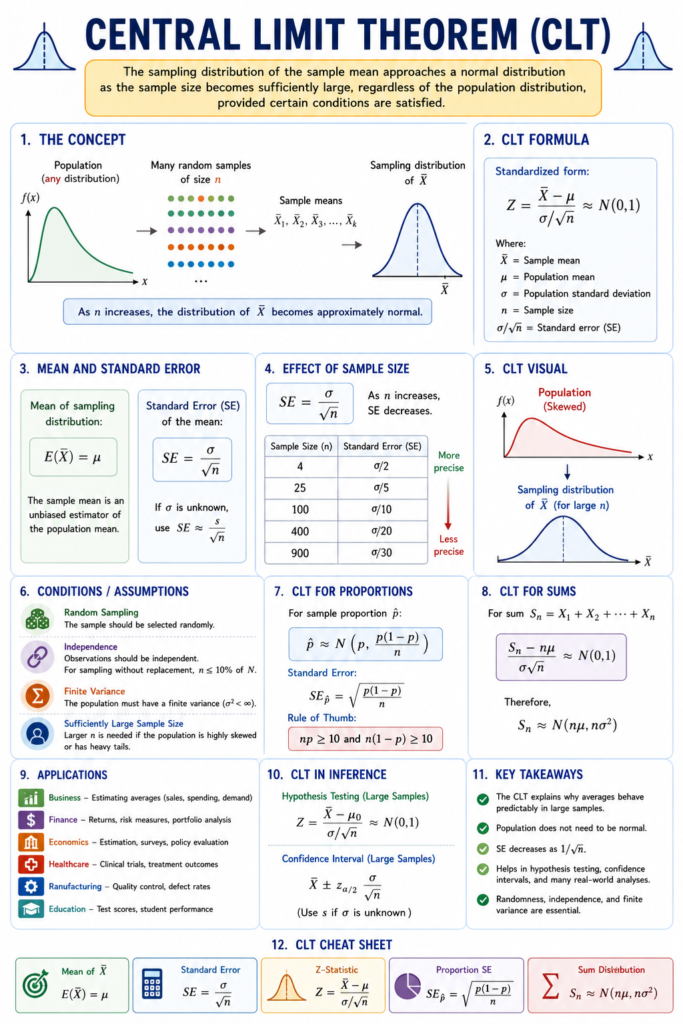
The Central Limit Theorem (CLT) states that the sampling distribution of the sample mean becomes approximately normal as the sample size grows — regardless of the original population’s distribution, provided the observations are independent and the population has finite variance.
Mean: \(\mu_{\bar{X}} = \mu\) • Standard Error: \(\sigma_{\bar{X}} = \frac{\sigma}{\sqrt{n}}\)
It allows us to make probabilistic statements about sample means using the normal distribution, even when the population is not normal. This underpins confidence intervals, hypothesis tests, and regression inference.
where \(\sigma / \sqrt{n}\) is the standard error of the mean.
If \(\sigma\) is unknown, estimate it with the sample SD \(s\): \(\ SE \approx s / \sqrt{n}\).
There is no universal cutoff. While \(n \ge 30\) is a common introductory guideline, highly skewed or heavy‑tailed distributions may require much larger samples. The CLT is asymptotic — the approximation improves with \(n\).
Simulate the sampling distribution of the mean from a right‑skewed population.